Online casino players often want to know whether a game result was generated fairly. Traditional casino games rely on regulated equipment, audits, and independent testing, while online games use software to generate results. This raises an important question: what is provably fair, and can players actually check whether an online casino game produced a result honestly?
A provably fair system is a cryptographic method designed to let players verify that certain game results were not changed after the betting process began. It is particularly common in cryptocurrency-based online casinos and gambling platforms. Instead of asking players to simply trust the operator, the system gives them information that can be used to independently check the result.
However, provably fair does not mean that players are guaranteed to win. It also does not automatically mean that an online casino is licensed, secure, or trustworthy. The technology mainly addresses whether the random outcome was generated and preserved according to the stated rules.
This guide explains what is provably fair in online casinos, how the technology works, what information is involved, and how to verify provably fair results.
So, what does provably fair mean in practical terms?
Provably fair refers to a system where cryptographic techniques allow users to verify that a game outcome was generated fairly according to predefined inputs. The casino normally commits to information before the result is revealed, while another piece of information is supplied or selected during gameplay.
After the game, players can use the disclosed information to reproduce or verify the result.
The central idea is simple:
The casino should not be able to secretly change the outcome after committing to the information used to generate it.
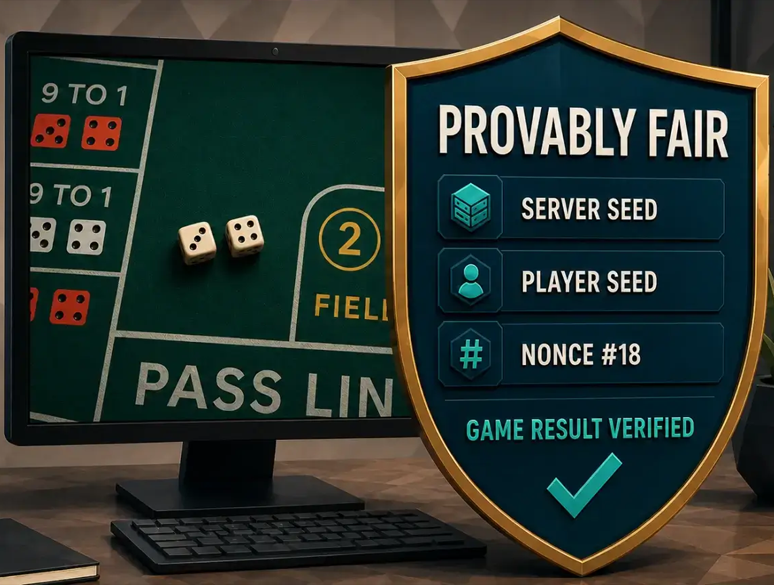
A common system uses three main components:
These values can be combined using a cryptographic algorithm to produce a game result.
The exact implementation differs between casinos and games. Some platforms may use additional values, different hashing algorithms, or alternative randomization methods.
Understanding how does provably fair work becomes easier when looking at the process step by step.
The Casino Creates a Server Seed
Before gameplay, the casino generates a random server seed.
Instead of immediately showing the seed to the player, the casino typically creates a cryptographic hash of it. A hash is a one-way mathematical function that converts information into a fixed-length string.
For example, a simplified illustration might look like:
Server Seed → SHA-256 Hash → 8f3a…
The player sees the hash rather than the original server seed.
This creates a commitment. The casino can later reveal the original seed, allowing the player to check whether it matches the hash that was originally displayed.
The Player Uses a Client Seed
A client seed is another value used by the provably fair algorithm.
Depending on the platform, the player may be able to choose this value or receive one automatically. Giving players control over the client seed can provide an additional layer of transparency because the casino cannot unilaterally determine every input.
The client seed can be a random string such as:
player12345
The actual value and format depend on the casino’s implementation.
A Nonce Tracks Game Rounds
A nonce is normally an incremental number associated with individual game rounds.
For example:
The nonce helps ensure that the same seeds can generate different results across multiple rounds.
The Inputs Are Combined
The server seed, client seed, nonce, and sometimes additional information are processed by the casino’s algorithm.
A simplified formula might look like:
Result = Algorithm(Server Seed + Client Seed + Nonce)
In real systems, the calculation may use HMACs, hashes, hexadecimal conversion, numerical transformations, or other cryptographic processes.
The result is then mapped to the particular game.
For example, a number generated by the algorithm might be converted into:
The exact process should be explained in the casino’s provably fair documentation.
One of the most important parts of provably fair gambling is the timing of information disclosure.
If the casino showed the original server seed before a game, someone might potentially use it to predict outcomes, depending on the system design.
Instead, the casino usually shows a hash of the server seed before gameplay.
A cryptographic hash has a useful property: it is computationally difficult to reverse the hash and recover the original input.
After a seed cycle ends, the casino can reveal the original server seed. The player can then hash it independently and compare the result with the previously displayed hash.
If the hashes match, the casino used the same server seed it committed to earlier.
This is called a commit-reveal approach.
Provably fair games are online casino or gambling games that use a verification mechanism allowing players to examine the inputs and calculations behind game results.
They can include games such as:
Not every game described as provably fair uses exactly the same verification process.
For example, a simple dice game may generate a number directly from cryptographic inputs. A card game may need to create a complete shuffled deck before determining which cards are dealt.
Therefore, players should read the individual game’s verification method rather than assuming that every provably fair game works identically.
A provably fair casino is an online gambling platform that offers games using a system designed to let users independently verify game outcomes.
The main benefit is transparency around the randomization process.
However, provably fair should not be treated as a synonym for “safe casino.”
A platform can use a transparent game-generation system while still raising other questions about:
Provably fair technology addresses a specific technical question: Can the stated game result be independently checked against the system’s committed inputs?
It does not answer every question about an online gambling operator.
Traditional online casinos commonly rely on independent testing laboratories, regulatory oversight, and audits of random number generators.
A provably fair system takes a different approach by giving the user cryptographic information that can be used to verify individual outcomes.
These approaches can complement rather than necessarily replace one another.
| Feature | Provably Fair | Traditional RNG Testing |
| Main focus | Verifying game results cryptographically | Testing randomness and game software |
| User verification | Often possible | Usually performed by independent testers |
| Individual result checking | Usually possible when data is available | Not normally performed by individual players |
| Main technology | Cryptographic algorithms | RNG testing, audits, technical standards |
| Operator oversight | Depends on platform | May involve regulators and testing laboratories |
A player should therefore distinguish between technical transparency and regulatory oversight.
One of the most useful questions is how to verify provably fair results yourself.
The exact process depends on the casino, but a typical verification process looks like this.
Step 1: Find the Provably Fair Section
Look for a page or menu labeled:
The platform should explain its algorithm and inputs.
If there is no explanation of how results can be checked, it is difficult for a user to independently evaluate the system.
Step 2: Record the Server Seed Hash
Before playing, note the server seed hash.
This is the commitment made by the casino before the original server seed is revealed.
You can save or screenshot the hash for comparison later.
Step 3: Check the Client Seed
Look at the client seed associated with the game.
If the platform allows you to change the client seed, understand when the new seed becomes active. Some systems require a new seed to be generated before another game cycle begins.
Step 4: Record the Nonce
Find the nonce associated with the specific game round.
The nonce is important because it can distinguish one result from another when the same server and client seeds are used.
Step 5: Obtain the Revealed Server Seed
When the seed cycle ends or the casino allows the server seed to be revealed, obtain the original server seed.
You can now compare it with the earlier server seed hash.
Step 6: Hash the Server Seed
Use the hash algorithm specified by the casino.
If the platform says it uses SHA-256, for example, the revealed server seed should produce the same SHA-256 hash that was displayed before gameplay.
If the values match, the commitment check passes.
Step 7: Reproduce the Game Calculation
The final step is to use the server seed, client seed, nonce, and any additional required inputs according to the casino’s published algorithm.
The calculated result should match the original game outcome.
A proper verifier may automate this calculation for the player.
A Simple Example
Imagine a hypothetical dice game uses:
Before playing, the casino displays a hash of its server seed.
The player then places a bet.
The system combines the relevant inputs and generates a cryptographic value. That value is converted into a dice result, such as a number between 0 and 99.99.
Later, the casino reveals the server seed.
The player can:
Hash the revealed server seed.
Compare that hash with the original commitment.
Enter the server seed, client seed, and nonce into the verifier.
Reproduce the calculation.
Compare the calculated result with the recorded result.
If the values match, the result is consistent with the published provably fair algorithm.

It is important not to overstate the technology.
A successful verification does not necessarily prove that:
Provably fair systems are designed for a narrower purpose: verifying that game outcomes correspond to the disclosed cryptographic process.
A common misunderstanding is that if players can verify a result, they can also predict the next result.
Generally, these are different concepts.
Verification happens after the necessary information is available. Prediction would require knowing information that should remain hidden before the outcome is generated.
A properly designed cryptographic system is intended to prevent players from deriving the hidden server seed from its hash.
However, the security of the system depends on its implementation. Weak random-number generation, poor seed management, flawed algorithms, or programming mistakes can undermine a supposedly provably fair system.
This is why technical documentation matters.
“Provably fair means you cannot lose.”
False.
Provably fair describes the transparency of the outcome-generation process. It does not eliminate the house edge or change the mathematical odds of the game.
“Every crypto casino is provably fair.”
False.
Some cryptocurrency gambling platforms may advertise provably fair games, while others may not provide such verification.
“A verified result means the casino is trustworthy in every way.”
Not necessarily.
A game can pass a cryptographic verification while other aspects of the operator require separate evaluation.
“Provably fair is the same as being regulated.”
No.
Regulation and provable fairness serve different purposes. Regulation can involve licensing, compliance requirements, audits, consumer protections, and other obligations.
“You need to understand advanced mathematics to verify a result.”
Not always.
Many platforms provide automated verification tools. Nevertheless, understanding the basic concepts helps users know what information they are checking and why.
The biggest advantage is transparency.
Instead of requiring users to accept a game result solely because the operator says it was random, the system can provide data that allows independent verification.
Other potential benefits include:
Greater transparency: Players can inspect the inputs and calculation process.
Individual result verification: Users may be able to check particular game rounds.
Cryptographic commitment: A server seed hash can make it harder for an operator to change the committed seed later without detection.
Open verification: Depending on the implementation, users may be able to reproduce the calculation themselves.
Better understanding of game mechanics: The verification process can show players how outcomes are generated.
Limitations and Risks
Provably fair systems also have limitations.
The first is implementation quality. A platform can use the phrase “provably fair” while providing a complicated or poorly documented system.
The second is incomplete transparency. If important parts of the algorithm remain unexplained, users may have difficulty reproducing the result.
Third, provable fairness does not eliminate broader online gambling risks. Players should still consider account security, privacy, payment safety, local laws, and responsible gambling practices.
Finally, a cryptographically verified outcome can still be unfavorable. Fair randomness means that losing outcomes remain possible.
Before using a game that claims to be provably fair, consider these questions:
Is the verification algorithm publicly explained?
Can the server seed be verified after the seed cycle?
Is the server seed hash provided before gameplay?
Can the client seed be viewed or changed?
Is the nonce clearly recorded?
Can individual results be reproduced?
Does the verification tool explain its calculations?
Are the game’s odds or house edge clearly disclosed?
Is the operator’s licensing status independently identifiable?
Are the platform’s security and privacy policies clear?
These questions help separate genuine technical transparency from simple marketing language.
So, what is provably fair? It is a cryptographic approach that allows users to check whether online game results were generated according to predefined and verifiable inputs.
A typical provably fair system uses a hidden server seed, a client seed, and a nonce. The casino first commits to the server seed by displaying its hash. After gameplay, the seed can be revealed, allowing the player to verify the commitment and reproduce the game result.
Understanding how does provably fair work can help online users distinguish technical game verification from broader claims about casino safety or fairness.
Provably fair games can provide an additional layer of transparency, but they do not guarantee wins, remove the house edge, or automatically make an operator licensed and trustworthy. For anyone researching what is provably fair in online casinos, the most important point is that it is a method for independently checking game-result generation—not a guarantee about every aspect of an online gambling platform.