

If you have spent time exploring Asian table games or browsing live casino lobbies, you have likely come across a fast-paced, five-card game known as Niu Niu—often translated into English as Cow Cow or Bull Bull. Combining the quick round times of Baccarat with the hand-building excitement of Poker, the niu niu game has become a staple across Southeast Asia, including Cambodia, Macau, and online live dealer platforms.
Unlike traditional Western poker where players bet across multiple streets, Niu Niu resolves every round in seconds. Players receive five cards and must divide them into two distinct groups—a three-card group and a two-card group—to form the highest possible point total. Because the math relies on multiples of ten, newcomers sometimes feel intimidated at first glance, yet once you understand the core grouping mechanic, the cow cow card game is remarkably intuitive.
In this complete guide, we break down what is niu niu card game, walk through how to play niu niu for beginners, explain the exact niu niu card rankings, and compare it directly with Baccarat so you can sit at any table with confidence.
Niu Niu (written as 牛牛 in Chinese, pronounced niú niú) literally translates to “Bull Bull” or “Cow Cow.” Originating in southern China—specifically Guangdong and Guangxi provinces—the chinese poker cow cow format grew out of traditional social card games played during holidays and family gatherings before making the leap into land-based casinos and live-streamed gaming studios.
At its heart, Niu Niu is a banking comparison game rather than a player-versus-player showdown. In every round, one participant acts as the Banker (either the house dealer in an online casino or a rotating player in home games), while everyone else plays as a Player competing directly against the Banker’s hand. You do not need to beat the other players sitting beside you; your sole objective is to construct a stronger five-card combination than the Banker.
Why is the game named after cows? In Cantonese and Mandarin slang, hitting a multiple of ten with your three-card base is referred to as having a “Bull” or “Cow” (Niu). When both your three-card group and your two-card group equal multiples of ten, you achieve the ultimate standard hand: Niu Niu (Double Cow). Because high-ranking hands in many casino variants trigger payout multipliers—sometimes paying 2x, 3x, or even 5x your initial wager—the game carries a dynamic risk-and-reward energy that keeps every deal suspenseful.
Learning niu niu game rules explained in plain language comes down to mastering a simple three-step flow: placing your bet, splitting your five cards into a 3+2 configuration, and comparing your result against the Banker.
Step 1: Placing Bets and Determining the Banker
Before any cards leave the shoe, players place their wagers in the designated betting boxes. In live dealer casinos, the house permanently serves as the Banker, and players typically choose between two betting styles:
Step 2: Dealing the Five Cards
Once bets are locked, the dealer deals five cards to the Banker and five cards to each active Player position. Depending on the table format, the cards may be dealt face-down (allowing players to squeeze and arrange their own hands) or face-up (where the casino software automatically arranges the optimal combination for every seat).
Step 3: Splitting Into Two Groups (The 3 + 2 Rule)
This is the defining rule of how to play niu niu. Every participant must divide their five cards into two separate sets:
The Base Group (3 Cards): You must find three cards whose combined point value adds up to 10, 20, or 30 (any exact multiple of 10).
The Point Group (2 Cards): The remaining two cards are added together, and only the last digit of their sum determines your hand’s rank.
If you cannot find any three cards among your five that add up to a multiple of 10, your hand is classified as No Niu (No Bull), which is the lowest tier in the game.
Step 4: Showdown and Settlement
After all hands are arranged, the Banker reveals their cards and compares them individually against each Player position:
How Many Cards Are Used in Niu Niu?
Standard niu niu rules use a single 52-card French deck with the Jokers removed. Unlike multi-deck shoes in Blackjack or Baccarat where eight decks are shuffled together, traditional Niu Niu relies on a single 52-card deck shuffled thoroughly before every single round.
Because a single deck contains 52 cards and each hand requires 5 cards, a physical table can comfortably accommodate up to 10 participants (1 Banker and up to 9 Players, using 50 cards total). In online live casino versions, tables typically feature one Banker hand and three Player positions (often labeled Player 1, Player 2, and Player 3), allowing unlimited remote users to bet behind any of the three Player spots while using only 20 cards per deal.
Shuffling a fresh 52-card deck after every hand ensures that card counting is impossible and guarantees that every round starts with identical mathematical probabilities.
Before you can calculate combinations, you need to know the exact numerical value assigned to each card in the deck. Fortunately, the scoring system is straightforward and mirrors Baccarat in how face cards are treated:
| Card Rank | Point Value in Niu Niu | Notes |
| Ace (A) | 1 point | Always counts as 1, never 11. |
| 2 through 9 | Face value (2–9 points) | Counted at their exact printed number. |
| 10 | 10 points | Acts as an automatic multiple of 10. |
| Jack (J) | 10 points | Treated identically to a 10 for point math. |
| Queen (Q) | 10 points | Treated identically to a 10 for point math. |
| King (K) | 10 points | Treated identically to a 10 for point math. |
Keep two important rules in mind regarding card values:
For Point Calculation: All 10s, Jacks, Queens, and Kings are worth 10 points. Having three face cards in your hand automatically gives you a base sum of 30 (a valid multiple of 10).
For Tiebreakers: Even though J, Q, K, and 10 all equal 10 points when adding numbers, their individual hierarchy for breaking ties follows traditional card rank order: King > Queen > Jack > 10 > 9 > 8 > 7 > 6 > 5 > 4 > 3 > 2 > Ace. If you are new to card hierarchies, reviewing standard poker hand rankings can also help reinforce how card ranks and suits interact during tiebreakers.
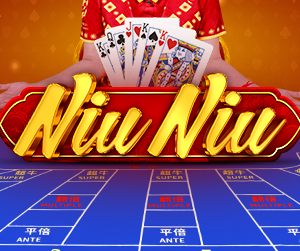
Understanding the niu niu card ranking order is essential for knowing how strong your hand is and what payout multiplier you stand to win. Below is the complete hierarchy of niu niu card combinations, ordered from the strongest possible hand at the top down to the weakest hand at the bottom.
| Rank Tier | Hand Name | How It Is Formed | Typical Multiplier Payout |
| 1 (Highest) | Five Small Niu (Wu Xiao Niu) | All 5 cards are under 5 (A, 2, 3, or 4) AND their total sum is 10 or less. | 5x – 8x |
| 2 | Four of a Kind (Bomb / Zha Dan) | Four cards of the exact same rank plus any fifth card (e.g., 7-7-7-7-K). | 4x – 5x |
| 3 | Five Face Cards (Wu Hua Niu) | All 5 cards are Jacks, Queens, or Kings (no 10s included). | 3x – 5x |
| 4 | Niu Niu (Cow Cow / Bull Bull) | 3 cards sum to a multiple of 10, AND the remaining 2 cards also sum to 10 or 20. | 3x |
| 5 | Niu 9 | 3 cards sum to a multiple of 10; remaining 2 cards end in 9 (9 or 19). | 2x |
| 6 | Niu 8 | 3 cards sum to a multiple of 10; remaining 2 cards end in 8 (8 or 18). | 2x |
| 7 | Niu 7 | 3 cards sum to a multiple of 10; remaining 2 cards end in 7 (7 or 17). | 1x – 2x |
| 8 | Niu 6 | 3 cards sum to a multiple of 10; remaining 2 cards end in 6 (6 or 16). | 1x |
| 9 | Niu 5 | 3 cards sum to a multiple of 10; remaining 2 cards end in 5 (5 or 15). | 1x |
| 10 | Niu 4 | 3 cards sum to a multiple of 10; remaining 2 cards end in 4 (4 or 14). | 1x |
| 11 | Niu 3 | 3 cards sum to a multiple of 10; remaining 2 cards end in 3 (3 or 13). | 1x |
| 12 | Niu 2 | 3 cards sum to a multiple of 10; remaining 2 cards end in 2 (2 or 12). | 1x |
| 13 | Niu 1 | 3 cards sum to a multiple of 10; remaining 2 cards end in 1 (11). | 1x |
| 14 (Lowest) | No Niu (No Bull) | No combination of 3 cards can add up to 10, 20, or 30. | 1x (Loss) |
(Note: Exact payout multipliers can vary slightly depending on the casino provider or house rules, particularly for special hands and Niu 7.)
If you are playing online, the software calculates your optimal 3+2 split automatically. However, knowing how to read your hand yourself makes the game far more enjoyable—especially when squeezing cards in a live dealer studio or playing with friends.
Follow this quick mental checklist whenever you look at five cards:
Separate your 10-value cards first. Group any 10s, Jacks, Queens, and Kings together.
Practical Examples
Above the standard Niu Niu (Double Cow) combination sit three rare, high-paying Special Hands. When you land one of these combinations, you do not need to form a traditional 3+2 multiple-of-ten split—the hand automatically outranks every standard Niu combination on the table.
Five Face Cards (Wu Hua Niu / Gold Bull)
Four of a Kind (Bomb / Zha Dan)
Five Small Niu (Wu Xiao Niu)
(Note: Some regional or online variations also include Straight Flush Niu or Five-Card Flush in their paytables, so always glance at the table’s info icon before placing multiplier wagers.)
Because both games are wildly popular across Asian casino floors and share similar card-point valuations (10s and face cards equaling zero/ten), beginners often wonder how Niu Niu compares to Baccarat. If you enjoy reading Baccarat roadmaps or comparing fast table games like Baccarat vs Dragon Tiger, understanding how Niu Niu differs will help you pick the right table for your style.
| Feature | Niu Niu (Cow Cow) | Baccarat |
| Cards Dealt per Hand | 5 cards (split into 3 + 2 groups) | 2 to 3 cards (fixed drawing rules) |
| Core Objective | Form a 3-card multiple of 10, then get closest to 10 with the remaining 2 cards | Get a 2- or 3-card total closest to 9 |
| Who You Bet On | You play as a Player position trying to beat the Banker’s hand | You can bet on Player, Banker, or Tie |
| Payout Structure | Variable multipliers (1x up to 5x+) depending on winning hand rank | Fixed payouts (1:1 on Player, 0.95:1 on Banker, 8:1 on Tie) |
| Bankroll Volatility | Moderate to High (multiplier bets can win or lose 3x–5x in one round) | Low (predictable single-unit wins and losses) |
| Pace & Skill Element | Fast, with light mental math to group 5 cards optimally | Very fast, zero player decisions after placing a bet |
In short, Baccarat offers steady, low-volatility, single-unit gameplay where you can freely back either side of the table, whereas Niu Niu delivers bigger swings, multi-card hand combinations, and the thrill of hitting a 3x or 5x multiplier payout on a single deal.
Is Niu Niu a game of luck or skill?
Niu Niu is primarily a game of luck because the cards are dealt randomly from a freshly shuffled 52-card deck every round. However, in live or home games where you arrange your own cards manually, spotting the optimal 3+2 combination quickly prevents costly misreads—such as accidentally declaring “No Niu” when a valid multiple of 10 was hiding in your hand.
What is the best possible hand in Niu Niu?
In standard casino rules, Five Small Niu (Wu Xiao Niu)—five cards all valued under 5 whose total sum is 10 or less—is the highest-ranking hand, followed by Four of a Kind (Bomb), Five Face Cards, and Niu Niu (Double Cow).
What happens if the Player and Banker have the exact same Niu rank?
If both hands finish with the same rank (for instance, both hold Niu 6 or both have No Niu), the winner is determined by comparing the single highest-ranking card among all five cards in each hand (King high down to Ace low). If both hands share the same highest card rank, suits break the tie in descending order: Spades > Hearts > Clubs > Diamonds.
Why do multiplier bets require a higher account balance?
When you place a multiplier (Double) bet in Niu Niu, you stand to win up to 3x or 5x your base stake if you hit a high-ranking hand. Conversely, if the Banker hits Niu Niu or Five Face Cards while you lose, you must pay the Banker at that same multiplier. Online casinos automatically hold a reserve equal to the maximum possible multiplier loss (usually 5x your bet) to ensure every wager can be settled fairly.
Can I play Niu Niu online safely in Cambodia?
Yes, most major live casino providers (such as Evolution, Pragmatic Play, SA Gaming, and Sexy Baccarat) offer live-streamed Niu Niu tables accessible on desktop and mobile. Always stick to licensed, reputable platforms and review tips on avoiding online casino scams in Cambodia before depositing funds so you can enjoy the game responsibly.