Understanding poker hand rankings is one of the most important steps for anyone learning poker. Whether you are playing Texas Hold’em, Omaha, or another popular poker variation, knowing which hands are stronger helps you understand the game and compare your cards with your opponents’ hands.
The basic idea is simple: the player with the strongest five-card poker hand usually wins the showdown. However, the strength of a hand depends on the combination of cards, not just the highest individual card. For example, a pair of aces is generally stronger than a pair of kings, but a straight beats both pairs.
There are 10 standard poker hand rankings, arranged from the Royal Flush, which is the highest-ranking hand, to the High Card, which is the lowest-ranking hand when no other combination is made.
This guide explains all 10 poker hands in order, provides examples of each combination, and introduces the poker hand ranking rules beginners should understand. By the end, you will know how to read a poker hand rankings chart, compare different combinations, and recognize the strongest possible five-card hand.
You can read more on: How to play Poker in cambodia
The following poker hand rankings chart shows all 10 standard poker hands from highest to lowest.
| Rank | Poker Hand | Example | Description |
| 1 | Royal Flush | A♠ K♠ Q♠ J♠ 10♠ | A, K, Q, J, and 10 of the same suit |
| 2 | Straight Flush | 9♥ 8♥ 7♥ 6♥ 5♥ | Five consecutive cards of the same suit |
| 3 | Four of a Kind | K♠ K♥ K♦ K♣ 3♠ | Four cards of the same rank |
| 4 | Full House | Q♠ Q♥ Q♦ 7♣ 7♥ | Three of a kind plus a pair |
| 5 | Flush | A♦ J♦ 8♦ 5♦ 2♦ | Five cards of the same suit, not consecutive |
| 6 | Straight | 9♠ 8♥ 7♦ 6♣ 5♠ | Five consecutive cards of different or mixed suits |
| 7 | Three of a Kind | 8♠ 8♥ 8♦ K♣ 4♥ | Three cards of the same rank |
| 8 | Two Pair | J♠ J♦ 5♣ 5♥ A♠ | Two different pairs |
| 9 | One Pair | A♠ A♥ 10♦ 7♣ 3♠ | Two cards of the same rank |
| 10 | High Card | A♠ J♦ 8♣ 5♥ 2♠ | No qualifying combination |
Important: The suits are shown only to illustrate the combinations. In standard poker, suits do not have different values for breaking ties.
These are the traditional poker hands in order used in standard high-hand poker games. Some poker variants use different rules, so always check the rules of the specific game.
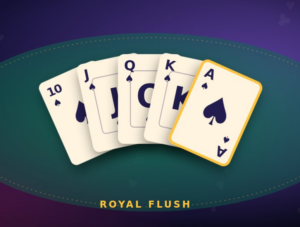
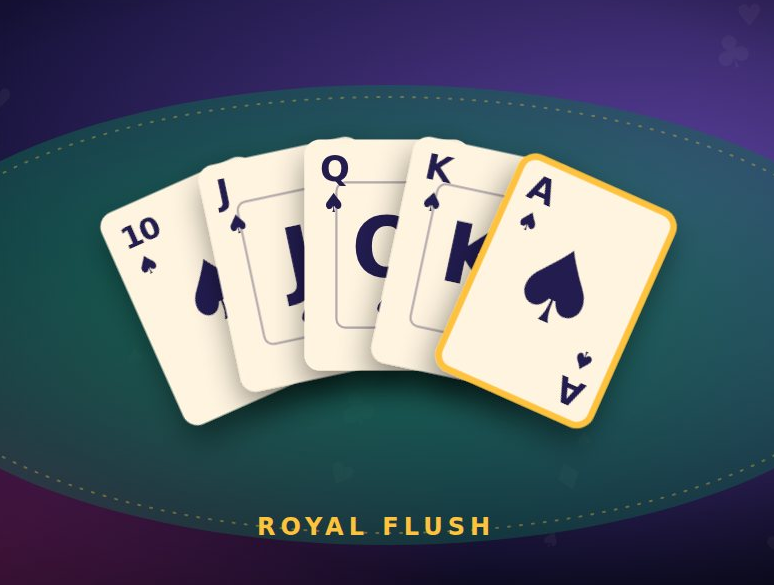
Royal Flush
Highest-ranking poker hand
A♠
K♠
Q♠
J♠
10♠
Example: Ace-high straight flush in spades
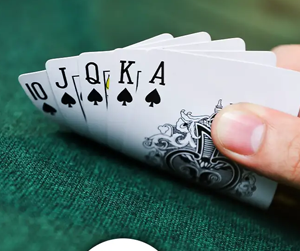
The Royal Flush is the strongest possible hand in standard poker. It consists of five consecutive cards from 10 through Ace, all belonging to the same suit.
The five cards must be:
All five cards must share the same suit, such as hearts, diamonds, clubs, or spades.
For example, A♠ K♠ Q♠ J♠ 10♠ is a Royal Flush.
A Royal Flush is technically the highest possible type of straight flush. It cannot be beaten by any other standard poker hand.
Example: If one player has a Royal Flush and another has Four of a Kind, the Royal Flush wins.
Royal Flushes are extremely rare in five-card poker. Beginners should recognize this hand, but they should not expect to make it frequently.
Straight Flush
Five consecutive cards of the same suit
9♥
8♥
7♥
6♥
5♥
Example: Nine-high straight flush
A Straight Flush consists of five consecutive cards of the same suit. It ranks below a Royal Flush but above Four of a Kind.
For example, 9♥ 8♥ 7♥ 6♥ 5♥ forms a Straight Flush because the cards are consecutive and all hearts.
Another example is 6♣ 5♣ 4♣ 3♣ 2♣.
The highest card determines the strength of a Straight Flush. A 9-high Straight Flush beats an 8-high Straight Flush.
The Ace can be used at the top or bottom of a straight. For example, A-2-3-4-5 is the lowest straight, while 10-J-Q-K-A is the highest. An Ace cannot wrap around to create Q-K-A-2-3.
A Straight Flush is powerful because it combines two strong features: consecutive ranks and a matching suit.
Four of a Kind
Four cards of the same rank
K♠
K♥
K♦
K♣
3♠
Example: Four kings with a three kicker
Four of a Kind, also called quads, contains four cards with the same rank and one additional card.
For example, K♠ K♥ K♦ K♣ 3♠ is Four of a Kind because all four kings have the same rank.
The extra card is known as the kicker. It can help determine the winner when two players have the same four-of-a-kind rank.
For example:
Player B wins because the four kings are equal, but the 9 kicker is higher than the 3 kicker.
If two players have Four of a Kind of different ranks, the higher set wins. Four aces beats four kings.
In Texas Hold’em, Four of a Kind can be made using the community cards and a player’s hole cards. The best five-card hand determines the result.
Full House
Three of a kind plus one pair
Q♠
Q♥
Q♦
7♣
7♥
Example: Queens full of sevens
A Full House contains three cards of one rank and two cards of another rank. It is sometimes described using the phrase “three full of two.”
For example, Q♠ Q♥ Q♦ 7♣ 7♥ is a Full House consisting of three queens and a pair of sevens. It is called “queens full of sevens.”
When comparing two Full Houses, compare the three-of-a-kind portion first.
For example:
The queens-full hand wins because queens rank higher than jacks. The pair does not override the strength of the three-of-a-kind portion.
If both players have the same three-of-a-kind rank, the higher pair wins.
A Full House is stronger than a Flush and weaker than Four of a Kind. It is an important combination to recognize when learning poker hands from highest to lowest.
Flush
Five cards of the same suit, not consecutive
A♦
J♦
8♦
5♦
2♦
Example: Ace-high diamond Flush
A Flush consists of five cards of the same suit, regardless of whether their ranks are consecutive.
For example, A♦ J♦ 8♦ 5♦ 2♦ is a Flush because all five cards are diamonds.
If the cards were consecutive, the hand would be a Straight Flush instead.
When two players have a Flush, compare their highest cards first. If the highest cards are equal, compare the second-highest cards, then the third-highest, and continue until a difference appears.
For example, an Ace-high Flush beats a King-high Flush.
A Flush can look impressive because all five cards share a suit. However, in standard poker, it loses to a Full House, Four of a Kind, Straight Flush, or Royal Flush.
Remember that suits do not rank above one another. A Flush in hearts does not automatically beat a Flush in clubs.
Straight
Five consecutive cards in mixed or matching suits
9♠
8♥
7♦
6♣
5♠
Example: Nine-high Straight
A Straight consists of five consecutive card ranks. The cards do not need to share the same suit.
For example, 9♠ 8♥ 7♦ 6♣ 5♠ forms a Straight.
Another example is 10♣ J♦ Q♠ K♥ A♣, which is an Ace-high Straight.
The highest card determines which Straight wins. A 10-high Straight beats a 9-high Straight.
The Ace has a special role in straights. It can be the highest card in 10-J-Q-K-A or the lowest card in A-2-3-4-5. The second example is called a five-high straight.
A Straight ranks below a Flush but above Three of a Kind.
Beginners sometimes confuse a Straight with a Straight Flush. The difference is simple: a Straight Flush requires all five cards to share the same suit, while a regular Straight does not.
Three of a Kind
Three cards of the same rank
8♠
8♥
8♦
K♣
4♥
Example: Three eights with king-four kickers
Three of a Kind consists of three cards of the same rank and two unrelated cards. It is also known as trips or a set in certain poker contexts.
For example, 8♠ 8♥ 8♦ K♣ 4♥ contains three eights.
When comparing two Three of a Kind hands, the higher three-card rank wins. Three queens beats three eights.
If both players have the same three-of-a-kind rank, compare the remaining cards, called kickers, from highest to lowest.
For example, three eights with a king kicker beats three eights with a jack kicker if the next relevant kicker does not change the comparison.
In Texas Hold’em, a set usually refers to three of a kind made with a pocket pair and one matching community card. Trips often describes three of a kind made using one hole card and a pair on the board.
Both belong to the same official poker hand ranking.
Two Pair
Two separate pairs and one kicker
J♠
J♦
5♣
5♥
A♠
Example: Jacks and fives, with an Ace kicker
Two Pair consists of two different pairs and one additional card.
For example, J♠ J♦ 5♣ 5♥ A♠ contains a pair of jacks and a pair of fives. The Ace is the kicker.
To compare Two Pair hands, use these rules:
Compare the higher pair.
If the higher pairs are equal, compare the lower pair.
If both pairs are equal, compare the kicker.
For example, a hand with kings and threes beats a hand with queens and tens because the kings are the higher pair.
If both players have kings and threes, the kicker determines the winner when the five-card hands otherwise differ only in that card.
Two Pair ranks below Three of a Kind but above One Pair. It is a common hand in many poker games, including Texas Hold’em.
One Pair
Two cards of the same rank
A♠
A♥
10♦
7♣
3♠
Example: A pair of aces with ten-seven-three kickers
One Pair consists of two cards of the same rank and three other cards of different ranks.
For example, A♠ A♥ 10♦ 7♣ 3♠ forms a pair of aces.
A pair of aces beats a pair of kings because aces have a higher rank. However, if two players have the same pair, the remaining cards determine which five-card hand is stronger.
Compare the highest kicker first, followed by the second-highest and then the third-highest.
For example, a pair of queens with an Ace kicker beats a pair of queens with a King kicker if the other kickers do not produce a different result.
One Pair is stronger than High Card but weaker than Two Pair.
Although a single pair may not look particularly powerful compared with the higher combinations, it is still a recognized poker hand. Its strength depends on the rank of the pair and the other cards.
High Card
Lowest standard poker hand ranking
A♠
J♦
8♣
5♥
2♠
Example: Ace-high with no pair or other combination
A High Card hand occurs when the five cards do not form a pair, Two Pair, Three of a Kind, Straight, Flush, Full House, Four of a Kind, or Straight Flush.
For example, A♠ J♦ 8♣ 5♥ 2♠ is an Ace-high hand.
When two players both have High Card hands, compare the highest card. If those cards are equal, compare the second-highest card and continue until a difference is found.
For example, an Ace-high hand with a King as its second-highest card beats an Ace-high hand with a Queen as its second-highest card, assuming the remaining cards do not affect the comparison first.
High Card is the weakest of the 10 standard poker hand rankings. However, it can still win a showdown if every opponent has an even weaker High Card hand.
In Texas Hold’em, the best five-card hand is selected from the player’s two private cards and the five community cards. Sometimes, the best available hand is simply High Card.
Knowing the names of all 10 poker hands is only the beginning. You also need to understand how the game compares combinations when two or more players have similar hands.
The strongest category wins
The first rule is that a higher-ranking hand category beats a lower-ranking category.
For example:
The rank of an individual card does not override the category. A pair of aces does not beat a Straight simply because aces are high cards.
Compare card ranks when categories match
If two players have the same hand category, compare the relevant card ranks.
For example, Four of a Kind in aces beats Four of a Kind in kings. With Two Pair, compare the higher pair first and then the lower pair.
This rule helps players determine the winner without relying on card suits.
Kickers can decide the winner
A kicker is a card that does not form the main combination but helps break a tie.
Kickers matter in hands such as One Pair, Two Pair, Three of a Kind, and Four of a Kind. The number of kickers that matter depends on the hand category and how the best five-card hands compare.
For example, two players may each have a pair of aces, but one can win with a higher kicker.
Suits do not break ties in standard poker
In standard high-hand poker, spades, hearts, diamonds, and clubs have equal value. A spade is not automatically stronger than a heart.
If two players have identical five-card hands by rank, the pot is generally split between them. Poker rules for specific variants and unusual situations may differ, so check the rules of the game being played.
Only the best five-card hand counts
In Texas Hold’em, each player receives two private cards and shares five community cards with the other players. Each player makes the strongest possible five-card hand from those seven available cards.
You may use both private cards, one private card, or neither private card. The community cards alone can form the best hand for every player.
This is why reading the board is essential. If the strongest five cards are shared by everyone, players may tie even if their private cards differ.
Use this quick reference to remember the main differences between the 10 poker hands.
| Hand | What to Look For | Beats |
| Royal Flush | 10 through Ace, same suit | Every standard hand |
| Straight Flush | Five consecutive cards, same suit | Four of a Kind and below |
| Four of a Kind | Four matching ranks | Full House and below |
| Full House | Three matching ranks plus a pair | Flush and below |
| Flush | Five cards of the same suit | Straight and below |
| Straight | Five consecutive ranks | Three of a Kind and below |
| Three of a Kind | Three matching ranks | Two Pair and below |
| Two Pair | Two separate pairs | One Pair and High Card |
| One Pair | One matching pair | High Card |
| High Card | No qualifying combination | No other category |
This table is a useful poker hand rankings chart for beginners because it highlights both the card pattern and the relative strength of each hand.
Common Mistakes Beginners Make With Poker Hand Rankings
Learning poker hands becomes easier when you understand the mistakes that new players often make.
Confusing a Flush with a Straight Flush. A Flush requires five cards of the same suit. A Straight Flush requires five consecutive cards of the same suit.
Thinking that a higher card always wins. A pair of aces is strong, but a Straight beats it. Hand categories take priority over individual card values.
Comparing the wrong part of a Full House. Always compare the three-of-a-kind portion first. The pair matters only when the three-of-a-kind ranks are equal.
Assuming suits have different values. Standard poker does not use suit rankings to break ordinary showdown ties.
Forgetting the kicker. When the main combination is equal, the remaining relevant cards may decide the winner.
Using more than five cards to rank a hand. In standard high-hand poker, the final hand is evaluated using exactly five cards. In Texas Hold’em, players choose the best five from seven available cards.
Avoiding these mistakes will help you read the board more accurately and understand why one hand wins over another.
A simple way to remember poker hand rankings is to learn them in groups.
First, memorize the top four hands: Royal Flush, Straight Flush, Four of a Kind, and Full House. These are distinctive combinations that are easy to identify.
Next, remember Flush and Straight. A Flush uses one suit, while a Straight uses consecutive ranks.
Finally, memorize the lower four categories: Three of a Kind, Two Pair, One Pair, and High Card.
You can practice by looking at five cards and asking three questions:
Do any cards share the same rank?
Are the ranks consecutive?
Do all five cards share the same suit?
These questions help you identify most combinations. If more than one combination is possible, use the highest-ranking five-card hand available.
For example, a hand containing three queens and two sevens is a Full House, not merely Three of a Kind. The best five-card combination determines the classification.
You can also use practice hands to compare kickers and learn how ties work. With repeated practice, the rankings become easier to recognize without referring to a chart.
What are the 10 poker hands in order?
The 10 standard poker hands from highest to lowest are Royal Flush, Straight Flush, Four of a Kind, Full House, Flush, Straight, Three of a Kind, Two Pair, One Pair, and High Card.
What is the strongest hand in poker?
The Royal Flush is the strongest standard poker hand. It contains 10, Jack, Queen, King, and Ace, all of the same suit.
What is the weakest poker hand?
High Card is the lowest of the 10 standard hand categories. It applies when a five-card hand does not form any of the other recognized combinations.
Does a Flush beat a Straight?
Yes. In standard high-hand poker, a Flush ranks above a Straight because five cards of the same suit outrank five consecutive cards of mixed or matching suits.
Does Three of a Kind beat Two Pair?
Yes. Three of a Kind ranks above Two Pair in the standard poker hand rankings.
Can two players have the same poker hand?
Yes. Two players can have hands of the same category and rank. The remaining cards may decide the winner. If the best five-card hands are identical, the pot is generally split.
Are poker hand rankings the same in every poker game?
Not always. Texas Hold’em and Omaha generally use the standard high-hand rankings, but other variants may use lowball rankings, split-pot rules, or special hand-ranking systems. Always check the specific game’s rules.
How can beginners learn poker hand rankings quickly?
Start by memorizing the order from Royal Flush to High Card. Then practice identifying pairs, matching suits, consecutive ranks, and combinations of three or four matching cards. A poker hand rankings chart is useful for quick reference.
Understanding poker hand rankings is essential for learning how standard poker games work. The 10 hands range from the powerful Royal Flush to the basic High Card, with each category following a clear set of rules.
Remember the most important principles: stronger hand categories beat weaker ones, card ranks determine many ties, kickers can matter, and suits do not break ordinary ties in standard poker.
Keep a poker hand rankings chart nearby while practicing, and review the examples in this guide until you can identify each combination confidently. Learning these rules will help you understand showdowns, compare hands correctly, and build a stronger foundation in poker.