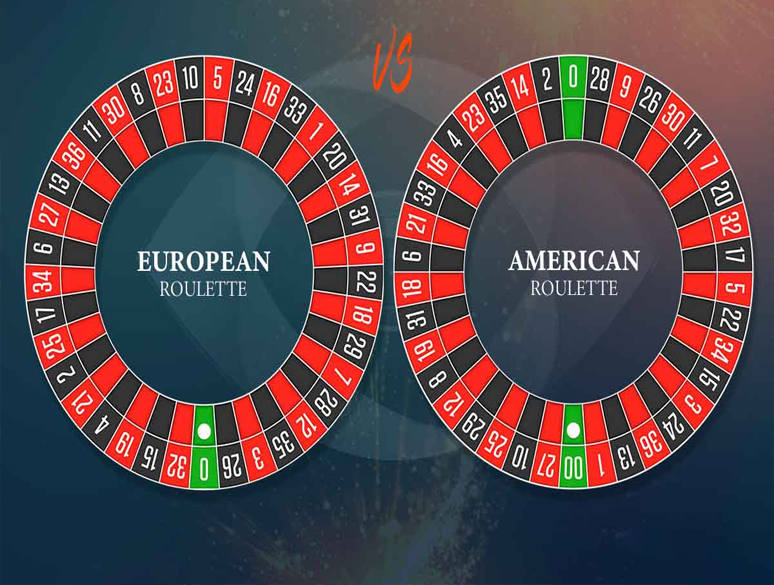
Roulette is one of the most recognizable casino games in the world, but not every roulette table follows exactly the same rules. The two most common versions are European roulette and American roulette. Although they look similar and use the same basic betting concept, an important difference between them can significantly affect the odds and house advantage.
Understanding the European roulette vs American roulette difference is useful for anyone who wants to learn how roulette works. The biggest distinction is the number of zero pockets on the wheel. European roulette has one zero, while American roulette has both a zero and a double zero. That extra pocket changes the mathematical probability of winning and increases the casino’s advantage.
This guide compares European roulette, American roulette, and European vs American roulette across their rules, wheel layouts, betting options, payouts, odds, and house edge. The goal is to provide an educational overview so readers can understand the differences before deciding which version they prefer.
European roulette is a version of roulette that uses a wheel containing 37 numbered pockets. The numbers range from 1 to 36, with a single green zero.
The wheel therefore contains:
The numbers are divided between red and black, while zero is green.
When a roulette spin begins, players place bets on the table. The dealer spins the wheel in one direction and rolls a ball in the opposite direction. The ball eventually lands in one of the numbered pockets, determining the winning number.
European roulette is especially popular because it has only one zero. From a mathematical perspective, this gives players better basic odds than American roulette.
The standard house edge on most European roulette bets is approximately 2.70% for the common even-money and standard inside bets.
American roulette uses a wheel with 38 pockets instead of 37. It contains all the numbers from 1 to 36, plus two green pockets:
This means the wheel has:
The addition of the double zero is the main feature that separates American roulette from European roulette.
The game still uses red, black, and green pockets, and many of the betting categories are similar. However, because there are 38 possible outcomes instead of 37, the probability of landing on any particular number is slightly lower.
For many standard bets, the American roulette house edge is approximately 5.26%.
That difference may appear small at first, but it is mathematically significant over many spins.
The easiest way to understand the European roulette vs American roulette difference is to compare the wheel, rules, odds, and house edge.
| Feature | European Roulette | American Roulette |
| Total pockets | 37 | 38 |
| Green pockets | 1 (0) | 2 (0 and 00) |
| Numbered pockets | 1–36 | 1–36 |
| Standard house edge | About 2.70% | About 5.26% |
| Single-number probability | 1/37 | 1/38 |
| Common even-money bet probability | 18/37 | 18/38 |
| Typical number layout | European | American |
| Double zero | No | Yes |
The most important takeaway is simple: American roulette has an extra zero pocket, which gives the house a larger mathematical advantage.
The basic roulette rules are similar in both versions.
Players can place different types of wagers before each spin. These can include bets on individual numbers, groups of numbers, colors, odd or even numbers, and high or low numbers.
Once betting closes, the dealer spins the wheel and releases the ball. When the ball settles, the winning pocket determines which bets receive payouts.
European Roulette Rules
European roulette has 37 pockets. Players can generally bet on:
The exact availability of certain bets can vary between casinos and tables.
American Roulette Rules
American roulette follows the same general process, but the wheel contains both 0 and 00.
The presence of 00 is particularly important because it does not belong to red, black, odd, even, high, or low number groups.
As a result, the extra pocket creates another outcome where many common bets lose.
The European roulette vs American roulette odds are different because the wheels contain different numbers of pockets.
In European roulette, there are 37 possible outcomes. Therefore, a single number has a probability of:
1 ÷ 37 ≈ 2.70%
In American roulette, there are 38 possible outcomes. A single number has a probability of:
1 ÷ 38 ≈ 2.63%
This might seem counterintuitive because the percentage for a particular number is slightly smaller in American roulette. More importantly, the casino’s advantage becomes larger because the additional 00 pocket creates another losing outcome for many bets.
Example: Red Bet
There are 18 red numbers.
In European roulette:
18 ÷ 37 ≈ 48.65%
In American roulette:
18 ÷ 38 ≈ 47.37%
Neither version gives a red bet a true 50% probability because the green zero pockets are excluded from red and black.
The difference becomes especially noticeable when comparing the house edge.
The European roulette vs American roulette house edge is one of the most important differences for players to understand.
For a standard straight-up bet and many common outside bets:
European Roulette
House edge:
2.70%
American Roulette
House edge:
5.26%
This means that, in theoretical long-term mathematical terms, the casino has a considerably larger advantage in American roulette.
For example, if a particular betting strategy has a 2.70% house edge in European roulette, the equivalent standard bet in American roulette may have a 5.26% house edge.
These percentages do not mean that a player automatically loses those exact percentages during a short session. Roulette outcomes are random, and individual results can vary significantly.
Instead, the house edge represents the mathematical advantage built into the game over a very large number of bets.
The 00 pocket is responsible for most of the difference.
Imagine a roulette wheel with only 36 numbers, 18 red and 18 black. A red-or-black bet would theoretically have a 50% chance of winning.
But real roulette adds green zero pockets.
European roulette has one green zero. Therefore:
American roulette adds another green pocket:
That second green pocket increases the casino’s mathematical advantage.
This is why the European roulette vs American roulette difference is more than simply a different-looking wheel.
Many standard payouts are the same in both versions.
For example, a straight-up bet on a single number typically pays 35 to 1.
Common outside-bet payouts can include:
The key issue is that the payout does not increase when the American wheel adds 00.
Therefore, the additional outcome benefits the casino rather than compensating the player.
This is an important point when comparing European roulette vs American roulette odds.
Some European roulette tables offer rules that can reduce the effective house edge on certain even-money bets.
Two well-known rules are La Partage and En Prison.
La Partage
Under La Partage, if a player makes an even-money bet such as red/black or odd/even and the ball lands on zero, the player may receive half of the wager back.
This rule can reduce the house edge on qualifying bets from approximately 2.70% to around 1.35%.
However, La Partage is not available at every European roulette table.
En Prison
The En Prison rule can also apply to certain even-money wagers.
When zero appears, instead of immediately losing the bet, the wager can remain “in prison” for the next spin under the table’s specific rules.
If the next spin wins, the original wager may be returned. If it loses, the wager is forfeited.
Because rules can differ between casinos, players should always check the table rules before playing.
The most recognizable feature of American roulette is the double zero.
On an American roulette wheel, the sequence includes both 0 and 00. These are usually green and are not considered red or black.
The 00 pocket makes the game mathematically less favorable than European roulette.
For example, suppose someone places a $10 red bet.
If the result is red, the player generally wins $10.
If the result is black, 0, or 00, the player loses the $10 wager.
There are 18 winning red pockets but 20 losing pockets.
Therefore, the probability of winning is:
18 ÷ 38 ≈ 47.37%
This illustrates why the extra zero matters.
From a mathematical perspective, European roulette has better odds for players.
The reason is straightforward:
If the objective is simply to choose the roulette version with the lower standard house advantage, European roulette is the more favorable option.
This does not mean European roulette guarantees a profit. Roulette is still a game based on random outcomes, and the house maintains an advantage on standard bets.
Players sometimes search for systems that they believe can overcome the house edge, such as betting progressions or number-pattern strategies.
However, the underlying probability of the wheel does not change because of a betting strategy.
For example, increasing a wager after a loss does not remove the zero or 00 from the wheel.
Likewise, previous results do not determine the next spin. If the ball has landed on black several times consecutively, that does not mathematically make red “due” on the next spin.
Understanding roulette odds is therefore more useful than relying on patterns.
A betting system can change the way money is wagered, but it cannot change the physical probability of the roulette wheel.
The wheel layouts are also different.
European roulette uses a single-zero layout with 37 pockets. American roulette uses the 38-pocket double-zero layout.
The ordering of numbers around the wheel differs between the two versions as well.
This can matter for certain specialized bets, particularly those based on neighboring numbers or sections of the wheel.
For beginners, however, the most important distinction is not the exact number sequence. It is the number of pockets and the resulting mathematical probabilities.
Both versions can be found in casinos and online gaming platforms, although their availability varies by region and operator.
European roulette is widely associated with European-style casino games and is also commonly offered online.
American roulette is particularly associated with casinos in the United States.
Some online platforms provide both options, allowing users to compare the rules and table formats directly.
When choosing between them, checking the number of zero pockets is one of the quickest ways to identify which version is being offered.
There are several misconceptions about the European roulette vs American roulette difference.
Mistake 1: Assuming All Roulette Wheels Are the Same
They are not. The number of pockets can vary depending on the roulette version.
Mistake 2: Ignoring the Zero
Zero is neither red nor black and affects the probability of many outside bets.
Mistake 3: Forgetting About 00
American roulette includes both 0 and 00. This extra pocket is the main reason its standard house edge is higher.
Mistake 4: Believing a Strategy Removes the House Edge
Betting systems cannot eliminate the mathematical advantage created by the wheel.
Mistake 5: Looking Only at Payouts
European and American roulette can offer similar payouts for many bets. The difference comes primarily from the probability of winning those bets.
For a quick summary:
European roulette
American roulette
The difference is primarily mathematical rather than procedural. Both games involve spinning the wheel, placing wagers, and predicting where the ball will land.
Is European roulette better than American roulette?
From a mathematical house-edge perspective, European roulette is generally more favorable because it has one fewer zero pocket.
What is the biggest European roulette vs American roulette difference?
The biggest difference is the number of green zero pockets. European roulette has one zero, while American roulette has both 0 and 00.
What are the European roulette vs American roulette house edge percentages?
Standard European roulette has a house edge of about 2.70%, while standard American roulette has a house edge of about 5.26%.
Do European and American roulette have the same payouts?
Many standard bets have the same payouts, including a typical 35-to-1 payout for a straight-up number bet. However, the probabilities and house edge differ.
Does American roulette have worse odds?
For standard bets, American roulette has a higher house edge because of the additional 00 pocket.
Can a roulette strategy overcome the house edge?
No betting strategy can change the underlying probability of the wheel. Strategies may change wager patterns, but they do not remove the mathematical house advantage.
The European roulette vs American roulette comparison becomes much easier once you understand the importance of the zero pockets.
European roulette has 37 pockets and one zero, giving it a standard house edge of approximately 2.70%. American roulette has 38 pockets because it includes both 0 and 00, increasing the standard house edge to approximately 5.26%.
The basic roulette rules and many payouts are similar, but the additional American roulette pocket changes the underlying roulette odds. This is why the European vs American roulette distinction matters when comparing the two games.
For players primarily interested in the mathematical difference, European roulette generally offers the lower standard house edge. Tables with special rules such as La Partage can provide an even lower house advantage on qualifying bets.
Ultimately, understanding the wheel layout, probabilities, payouts, and house edge is more useful than focusing on betting patterns or systems. Roulette outcomes are random, so no strategy can guarantee a particular result. The best approach is to understand the rules and probabilities before making any decisions.