Baccarat is a card game that uses scoreboards to record the results of previous hands. These scoreboards are commonly called baccarat roadmaps. They help players see which side won each hand, identify patterns in past results, and understand how a baccarat game has progressed.
There are several types of baccarat roadmaps, including the Big Road, Big Eye Boy, Small Road, Cockroach Pig, and Bead Plate. Each roadmap displays game results differently. Some show the sequence of Banker and Player wins, while others use colored marks to compare patterns on the main scoreboard.
For beginners, learning to read baccarat roadmaps can make the table easier to understand. However, it is important to know that these scoreboards record historical results. They do not reliably predict the next hand or change the mathematical odds of the game.
This guide explains what are baccarat roadmaps, how the main scoreboards work, the differences between the Big Road and Big Eye Boy, and how to read these displays correctly.
Baccarat roadmaps are visual scoreboards that display the outcomes of previous rounds. They are available at many traditional baccarat tables and online live-dealer baccarat games.
In standard baccarat, the two main outcomes are:
The names Banker and Player refer to the two competing hands. They do not necessarily represent the casino and the person playing the game.
Baccarat roadmaps organize these outcomes into grids, columns, colored circles, or other visual marks. Depending on the roadmap, the display may show every result individually or summarize relationships between previous results.
Baccarat scoreboards serve several purposes:
Record results: They show which side won previous rounds.
Display sequences: They make consecutive Banker or Player wins easier to see.
Compare patterns: Some roadmaps help players compare the current sequence with earlier sections of the scoreboard.
Support game understanding: They help beginners become familiar with the way baccarat results are presented.
A roadmap is a recordkeeping tool rather than a forecasting system. A sequence of Banker wins does not guarantee another Banker win, and a long sequence of Player wins does not mean that a Banker win is due.
Different baccarat roadmaps present the same game history in different ways. The most common displays include the Bead Plate, Big Road, Big Eye Boy, Small Road, and Cockroach Pig.
Bead Plate
The Bead Plate records individual hand outcomes in a straightforward grid. Each mark represents a round, making it useful for checking the history of Banker, Player, and Tie results.
Big Road
The Big Road organizes Banker and Player wins into columns. It makes consecutive wins and changes between the two sides easier to identify.
Big Eye Boy
Big Eye Boy is a derived roadmap. Instead of simply recording each winner, it compares parts of the Big Road according to a specific rule and marks the result with red or blue symbols.
Small Road and Cockroach Pig
These are additional derived roadmaps. They use different comparisons within the Big Road to show another view of its structure.
The exact appearance and colors can vary between casinos and online platforms. Always check the table’s legend if you are unfamiliar with its scoreboard.
The baccarat Big Road is one of the most recognizable scoreboards in baccarat. It displays Banker and Player outcomes in a grid, using different colors to distinguish the two sides.
In many traditional displays:
The Big Road generally does not place every hand in a simple left-to-right sequence. Instead, it groups consecutive wins into columns and moves to a new column when the winning side changes.
Imagine the following sequence of results:
| Hand | Result |
| 1 | Banker |
| 2 | Banker |
| 3 | Player |
| 4 | Player |
| 5 | Banker |
| 6 | Player |
| 7 | Player |
A simplified Big Road representation would look like this:
Illustrative Big Road · Not a prediction
B
B
P
P
B
P
P
B = Banker
P = Player
This simplified illustration groups winning streaks. Actual Big Road placement follows table-specific conventions, including rules for ties and columns that reach the bottom of the grid.
In a standard Big Road, the first result begins the first column. If the same side wins again, the next mark normally goes directly below the previous mark. When the winning side changes, a new column begins.
For example, two consecutive Banker wins appear in one column. If the Player wins next, the Player result starts another column. If the Player wins again, the next mark goes below it.
When a column reaches the bottom of the available grid, further results may extend horizontally according to the table’s display rules.
Players often use the Big Road to describe historical sequences. Common terms include:
These descriptions help explain what happened in earlier rounds. They do not establish that a particular pattern will continue.
A long Banker streak, for instance, is simply a series of previous Banker wins. It does not mean the next Banker hand is more likely to win because the streak exists.
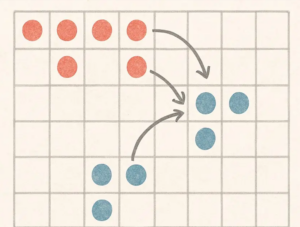
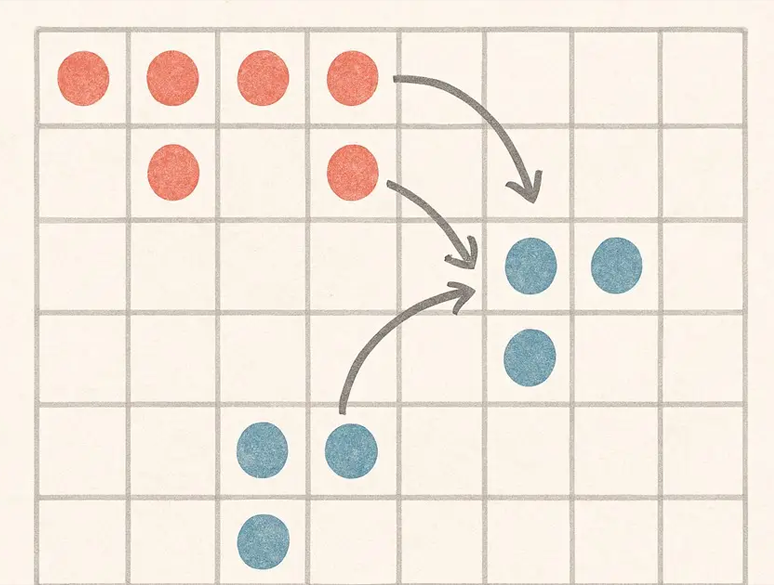
Baccarat Big Eye Boy is a derived roadmap that analyzes the structure of the Big Road. Unlike the Big Road, it does not directly record every Banker or Player winner.
Instead, it compares certain columns and positions in the Big Road to classify the relationships between them. The resulting marks are commonly displayed as small red or blue circles.
The purpose is to show whether parts of the Big Road follow similar or different structural patterns under the roadmap’s comparison rules.
Big Eye Boy uses the Big Road as its source. Its marking process generally follows these principles:
It waits until enough Big Road information is available to make a comparison.
It checks the relationship between specified columns or positions.
It applies the roadmap’s comparison rules to determine the mark.
It displays the result as a red or blue circle.
The exact rules involve comparing the lengths and positions of columns, including whether relevant columns have matching structures. The first few results may not generate Big Eye Boy marks because there may not yet be enough information.
Unlike the Big Road, Big Eye Boy does not directly tell you that Banker or Player won a particular hand. Its colors describe the result of a structural comparison.

On many standard baccarat displays, red and blue marks represent different outcomes of the comparison. They are not universal indicators of which side will win the next hand.
A common interpretation is:
However, implementations and terminology can differ. Some platforms explain the colors using concepts such as similarity and difference, while others use table-specific descriptions.
The safest approach is to read the legend provided by the casino or software rather than assuming that red always means Banker or blue always means Player.
Important: Big Eye Boy is not a separate betting game. It is a visual analysis tool based on recorded Big Road results.
The main difference between these two displays is what they represent.
| Feature | Big Road | Big Eye Boy |
| Main purpose | Records Banker and Player outcomes | Compares patterns within the Big Road |
| Data source | Actual hand results | Structure of the Big Road |
| Common marks | Red and blue circles | Smaller red and blue circles |
| Shows the winner of each hand directly | Generally yes | No |
| Requires previous results | Yes | Yes, including enough Big Road data |
| Predicts future results reliably | No | No |
The Big Road is generally easier for beginners because it shows the historical winners directly. Big Eye Boy is more abstract because it depends on comparisons between columns.
Someone who is learning baccarat scoreboards should understand the Big Road first. Once the main grid is familiar, learning derived roadmaps becomes easier.
The baccarat Bead Plate is another common scoreboard. It records each hand separately in a regular grid, making it one of the simplest roadmaps to understand.
Unlike the Big Road, which groups consecutive wins into columns, the Bead Plate typically places one mark in the next available cell for each completed hand.
For example, if the results are Banker, Player, Banker, Tie, and Player, the Bead Plate records those five results in order. It does not need to combine consecutive wins into streaks.
The Bead Plate is particularly useful for beginners who want a straightforward record of what happened.
The distinction between these displays is mainly their layout and organization.
| Feature | Bead Plate | Big Road |
| Layout | Regular grid filled sequentially | Columns organized by winning side |
| Records individual outcomes | Yes | Yes, using a different arrangement |
| Makes streaks easy to identify | Less directly | Yes |
| Shows changes between sides | Through consecutive marks | Through new columns |
| Beginner-friendly | Very easy to follow | Easy after learning its layout |
The Bead Plate answers a basic question: What happened in each round?
The Big Road makes another question easier to explore: How were the results grouped into streaks and changes?
Both are historical records. Neither one can tell you with certainty what will happen next.
Learning how to read baccarat roadmaps is easier when you approach each display in a logical order.
Step 1: Learn the Color Legend
Start by identifying the colors used for Banker, Player, and Tie results. Many standard displays use red for Banker and blue for Player, but platform conventions should always be checked.
For derived roadmaps, red and blue describe structural comparisons rather than the winning hand.
Step 2: Start With the Bead Plate
The Bead Plate is a useful starting point because each cell normally represents one hand. Follow the grid in the order indicated by the interface.
This helps you understand the sequence before interpreting more complex displays.
Step 3: Understand the Big Road’s Columns
Next, look at the Big Road. Consecutive wins by the same side usually continue downward within a column. A change in the winning side generally starts a new column.
Remember that a column represents a sequence of results, not a prediction about the next one.
Step 4: Compare the Derived Roadmaps
After understanding the Big Road, examine Big Eye Boy, Small Road, and Cockroach Pig.
These roadmaps use different rules to compare the Big Road’s structure. They can make historical relationships easier to see, but each one requires its own interpretation.
Step 5: Treat Ties Correctly
Tie results are often displayed differently from Banker and Player wins. A tie may receive a separate mark on the Bead Plate or appear as an indicator attached to an existing Big Road result.
The exact presentation depends on the platform. Check the table’s rules so that you do not mistake a tie marker for a new Banker or Player result.
Step 6: Separate Historical Information From Probability
This is the most important step. A roadmap shows previous outcomes, but it does not make independent future outcomes predictable.
For example, seeing four consecutive Banker wins tells you that Banker won four previous hands. It does not establish that Banker is due to lose, nor does it guarantee another Banker win.
Beginners sometimes misunderstand scoreboards because they treat visual patterns as reliable signals. Here are some common mistakes to avoid.
Mistake 1: Believing a Streak Must Continue
A streak may continue or end. The Big Road records which happened previously, but it cannot determine the next outcome.
Mistake 2: Assuming a Side Is Due to Win
The belief that a side must win after a long losing sequence is a form of the gambler’s fallacy. Previous independent outcomes do not create an obligation for a different result to occur.
Mistake 3: Confusing Big Eye Boy With the Big Road
The Big Road records the winners, while Big Eye Boy compares the Big Road’s structure. Their symbols serve different purposes.
Mistake 4: Assuming All Casinos Use Identical Displays
Although many baccarat scoreboards follow familiar conventions, interfaces can vary. Tie indicators, column placement, colors, and explanations may differ.
Mistake 5: Treating Roadmaps as Guaranteed Strategies
No roadmap can guarantee a win. A display that appears to show a strong pattern is still describing historical information rather than providing certain knowledge of future results.
Baccarat roadmaps can improve your understanding of the game’s history, but they do not inherently improve the mathematical probability of winning a hand.
Standard baccarat has different probabilities for Banker, Player, and Tie outcomes. These probabilities depend on the game’s rules and the cards remaining in the shoe. In ordinary casino baccarat, the Banker hand has a small statistical advantage over the Player hand, while Tie bets generally have a higher house edge.
The exact probabilities vary with the game format and rules. The presence of a streak on the scoreboard does not change those underlying rules.
Roadmaps can still be useful for learning, reviewing previous results, and following a live game. They simply should not be mistaken for predictive tools.
If you choose to play, set a fixed entertainment budget, avoid chasing losses, and stop when you reach your limit. Do not increase bets because a scoreboard appears to promise a particular result.
What are baccarat roadmaps?
Baccarat roadmaps are scoreboards that record previous game outcomes and display them in different formats. Common examples include the Bead Plate, Big Road, Big Eye Boy, Small Road, and Cockroach Pig.
How does the baccarat Big Road work?
The Big Road groups consecutive Banker or Player wins into columns. When the winning side changes, a new column generally begins. Its layout helps readers recognize historical streaks and changes.
What is baccarat Big Eye Boy used for?
Big Eye Boy compares the structure of the Big Road and displays the comparison using colored marks. It does not directly record each hand’s winner or reliably predict future outcomes.
Is the Bead Plate easier than the Big Road?
For many beginners, yes. The Bead Plate generally records each result in sequence, while the Big Road organizes consecutive wins into columns. Both are useful for understanding the game’s history.
Can baccarat roadmaps predict the next winner?
No. They summarize previous results and structural patterns. They cannot reliably determine whether Banker, Player, or Tie will occur in the next hand.
What is the difference between Big Eye Boy and Small Road?
Both are derived roadmaps, but they use different comparison rules to examine the Big Road. Their displays offer different views of its structure rather than direct records of every hand’s outcome.
Understanding baccarat roadmaps starts with learning what each scoreboard represents. The Bead Plate records individual results in a straightforward grid, while the Big Road organizes Banker and Player wins into columns. Big Eye Boy adds another layer by comparing structural patterns within the Big Road.
For beginners, the best approach is to learn the Bead Plate first, understand how the Big Road groups results, and then explore derived roadmaps such as Big Eye Boy.
Most importantly, remember that these displays describe past outcomes. They can help you read a baccarat table, but they cannot guarantee future results or remove the house edge. Treat them as tools for understanding the game, not as promises of winning.
If u interesting on read more on Where to play baccarat online in Cambodia